


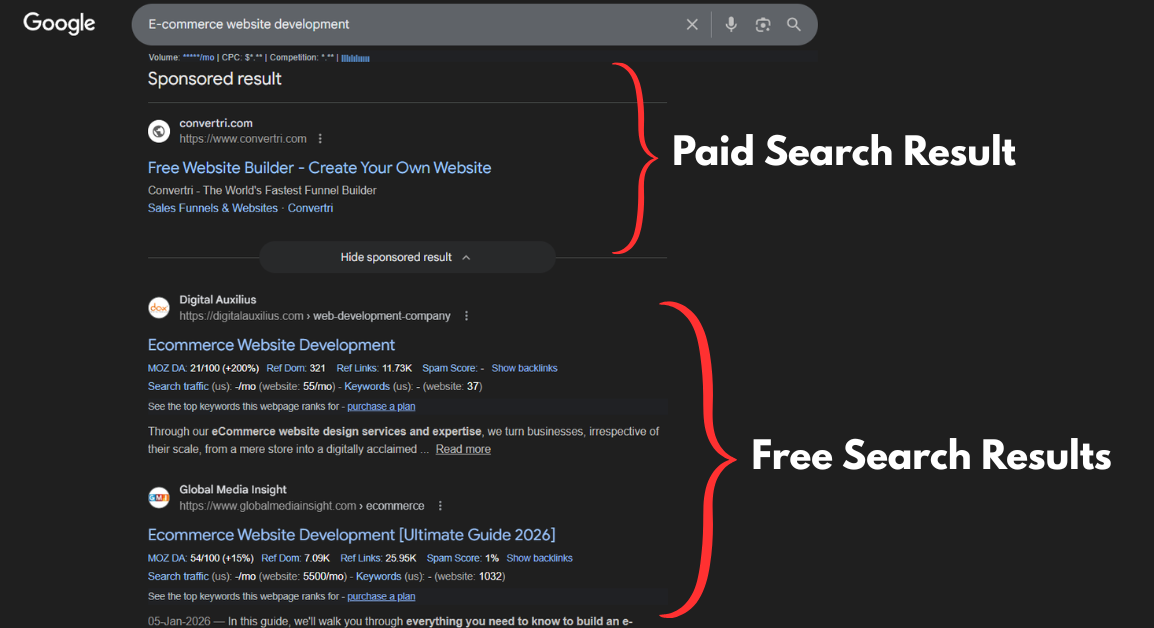
Search engines like Google, Yahoo, or Bing display different types of website links when we search for a particular thing on the Internet. If we enter a keyword in the search engine, the search engine will display the result on a page, which is known as the SERP, or the Search Engine Result Page. On the SERP page, we can see that there are both paid and unpaid links.
In this blog, we will be able to understand the concept of paid listings as well as organic listings, along with the difference between them, which is explained in a way that even a beginner can easily understand.
What Are Paid Listings on Search Engines
Paid listings are the links that appear on the search engine because a company has paid money to show them there. This part is also known as paid marketing on search engines.
When a business pays the search engine, its website link appears in the paid section. This method is often called Pay Per Click. It means the company pays money every time someone clicks on their link. Sometimes the cost per click can be very high depending on competition.
For example, if a company pays to show its ad on Google, its website will appear only on Google. If the company wants to appear on Bing or Yahoo, it must pay them separately.
Another important part of paid marketing on search engines is that if a company stops making a payment, its advertisement will no longer appear on the search engine results page.
Only about 20 percent of users click on paid listings. Most people prefer natural search results and trust them more than ads.
What Are Organic or Unpaid Listings
Organic listings are the unpaid results that appear on the search engine. The term organic refers to the term natural. The websites appear on the first page of the search engine due to proper optimization of the website according to the standards of the search engine.
In the case of organic listings, the website owners do not have to pay money to the search engine to display their websites on the search engine results page. They have to make the content of the website more useful and relevant to the search engines.
Almost 80 percent of users click on the organic results. This shows that people trust the results of the search engines more than the paid advertisements on the search engines.
Another major advantage of using the search engines is that if the website appears on the first page of the search engines through proper optimization, it will remain there for a longer period without paying money to the search engines per click. The website will appear on many search engines simultaneously if proper optimization is applied to the websites.
Unlike the case of the paid listings, the organic links do not disappear immediately, but remain as long as the quality of the website remains.
Both paid and organic listings are part of a bigger marketing strategy. Paid listings usually follow a push approach, while organic SEO is a strong example of pull marketing. If you wish to know more about the difference between push and pull marketing, you can read our detailed guide on What Is Marketing? Push vs Pull Marketing Explained.
Key Differences Between Paid and Organic Listings
Now let us clearly understand the difference between paid and unpaid listings in simple words.
| Features | Paid Listings | Organic Listings |
|---|---|---|
| Payment | Pay per click | No payment per click |
| User Trust | Lower trust | Higher trust |
| Click Rate | Around 20 percent users click | Around 80 percent users click |
| Duration | Visible only while paying | Can stay long term |
| Search Engines | Must pay each search engine separately | Can rank on multiple search engines |
| Speed | Instant visibility | Takes time to rank |
| Long Term Value | Short term traffic | Long term stable traffic |
As you can see from the comparison above, organic SEO builds long term value while paid marketing gives quick but temporary results.
Which One Is Better?
Both of them have their own importance. Paid marketing is helpful when you want quick visibility. If you want quick traffic, it is helpful.
For long-term traffic, organic SEO is helpful. With organic SEO, you do not have to pay for every click. That is why many businesses prefer SEO as a long-term approach.
The main thing behind both of these is to get visitors for your website. With organic SEO, not only do you get visitors, but you also get credibility.
Final Thoughts
Search engines show two main types of results. Paid listings appear because businesses pay money. Organic listings appear naturally because websites are properly optimized.
Most users prefer organic results. Paid results give instant visibility but disappear when payment stops. Organic results require effort and time, but they provide long term benefits.
If you are a beginner, it’s important to understand both methods clearly. To master Organic SEO on search engines and boost your website’s visibility naturally, our SEO Course is the perfect place to start.