


Project management is all about understanding which activities matter the most, how tasks are interconnected, and how delays ripple through an entire project. This is where the Critical Path Method (CPM) becomes a game changer.
Activity = A scheduled piece of work that consumes time and possibly resources. It has duration, start & finish dates, and dependencies. It is also the part of the schedule network diagram and appears in CPM (Critical Path Method).
“Task” is a more generic word. A unit of work to be performed.
Oracle Primavera P6 uses the term “Activity” and the Microsoft Project uses the term “Task”. But technically they both represent the same concept.
Whether you are preparing for the PMP exam or managing a real world construction, IT, or business project, mastering CPM will give you clarity, control, and confidence.
What Is the Critical Path Method?
The Critical Path Method (CPM) is a project scheduling technique developed in the late 1950s by Morgan Walker and James E. Kelley Jr.. It was first used at DuPont to solve scheduling inefficiencies and bring delayed projects back on track.
Critical Path Method helps us:
- Identify the longest sequence of dependent activities
- Determine the minimum time required to complete a project
- Understand which activities cannot be delayed
- Calculate slack (float) for non-critical tasks
Think of a group of friends planning to leave a restaurant. Everyone must finish eating before they leave. The slowest eater determines when the group can depart. That slowest eater represents the critical path.
Why Is CPM So Important?
Every project has:
- Multiple activities
- Dependencies between tasks
- Limited resources
- Strict deadlines
Without a structured method, managing these elements becomes chaotic. CPM allows you to:
- Visualize task relationships
- Predict completion time
- Identify risk areas
- Optimize scheduling decisions
For PMP aspirants, CPM is especially important because questions frequently test your understanding of:
- Forward pass
- Backward pass
- Float (Slack) calculation
- Critical path identification
Understanding Network Diagrams (Activity on Node)
CPM uses a network diagram, typically drawn using the Precedence Diagramming Method (PDM). Each activity is represented by a box containing:
- Activity Name
- Duration
- Early Start (ES)
- Early Finish (EF)
- Late Start (LS)
- Late Finish (LF)
- Total Float
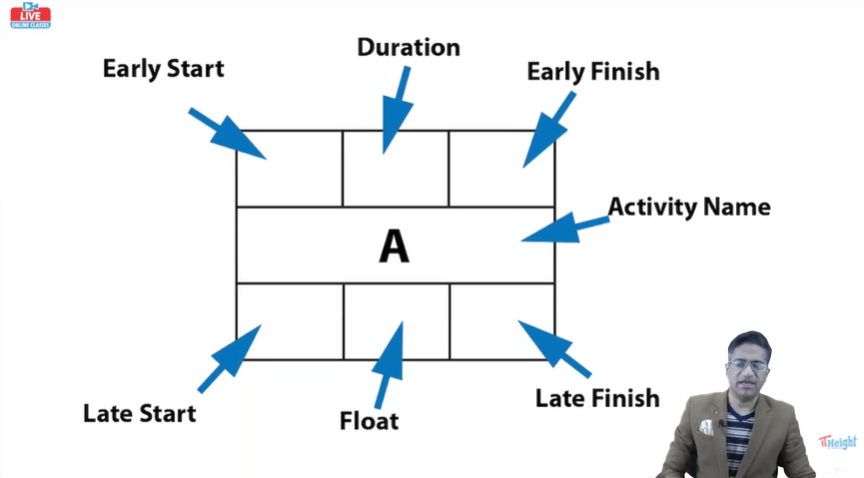
This structured format helps project managers analyze schedule flexibility.
The Four Types of Dependencies
Understanding dependencies is essential before calculating the critical path.
1. Finish-to-Start (FS)
The most common dependency. Example: A wall must be built before it can be painted.
2. Start-to-Start (SS)
Task 2 cannot start until Task 1 starts. Example: A lecture must begin before students start taking notes.
3. Finish-to-Finish (FF)
Task 2 cannot finish until Task 1 finishes. Example: Final grading must finish before report cards are completed.
4. Start-to-Finish (SF)
Rarely used. Example: A new security shift must begin before the old one ends.
The Six Steps of CPM
- Identify activities
- Sequence activities
- Draw the network diagram
- Estimate durations
- Perform forward and backward pass
- Identify the critical path
Forward Pass: Calculating Early Dates
The forward pass determines:
- Early Start (ES)
- Early Finish (EF)
Rules:
- ES of first activity = 0 (or Day 1, depending on method)
- EF = ES + Duration
- If multiple predecessors exist → choose the maximum EF
Example
If:
- Activity A finishes on Day 5
- Activity B depends on A
Then:
- B’s ES = 5
- If B duration = 4 → EF = 9
If Activity F depends on:
- D (finishes at 15)
- E (finishes at 13)
Then:
- F starts at 15 (maximum value)
This ensures no dependency is violated.
Backward Pass: Calculating Late Dates
The backward pass determines:
- Late Finish (LF)
- Late Start (LS)
Rules:
- Start from project completion time
- LS = LF − Duration
- If multiple successors exist → choose the minimum LS
This tells us how much delay is allowed without affecting project completion.
What Is Float (Slack)?
Float or Slack represents scheduling flexibility.
Total Float Formula:
TF = LS − ES (OR) TF = LF − EF
If slack = 0 → the activity is critical.
Real-Life Analogy
Imagine five friends leaving together. If one person is extremely slow, others may have spare time to make a quick phone call. That extra time is float. The slowest person has zero float, it means any delay affects everyone.
Identifying the Critical Path
The critical path is:
- The longest path through the network
- The shortest possible project duration
- The path with zero total float
If any activity on this path is delayed, the entire project is delayed. For example: If two paths exist:
- A → B → D → F (19 days)
- A → C → E → F (17 days)
The 19-day path is critical.
Total Float vs Free Float
Many students confuse these two.
Total Float
Maximum delay allowed without affecting project completion.
Free Float
Delay allowed without affecting the next activity. They are often equal, but not always.
Plus-Minus One Method vs Zero-Day Method
There are two common calculation styles:
Plus-Minus One Method
- Starts from Day 1
- Uses +1 and −1 adjustments
- Common in academic exams
Zero-Day Method
- Starts from Day 0
- Simple addition and subtraction
- No +1 or −1 confusion
Both methods produce the same critical path and float values.
CPM vs PERT
CPM is often compared with Project Management Institute-referenced scheduling techniques like PERT. Following are the key difference:
| CPM | PERT |
|---|---|
| Single time estimate | Three-point estimate |
| Deterministic | Probabilistic |
| Used for predictable projects | Used for uncertain projects |
CPM uses a single duration estimate, whereas PERT calculates duration using:
- Optimistic time
- Most likely time
- Pessimistic time
Benefits of CPM
Following benefits CPM provides:
- Clear schedule visibility
- Risk identification
- Better task prioritization
- Improved resource allocation
- Strong monitoring control
It also works seamlessly with Gantt charts, modern project management software can switch between both views instantly.
Common Mistakes Students Make
- Forgetting to choose the maximum EF in forward pass
- Forgetting to choose the minimum LS in backward pass
- Confusing float formulas
- Thinking critical path means “shortest path”
Remember: Critical path is the longest path that determines the earliest project completion.
Final Thoughts
The Critical Path Method is not just an academic formula, it is a strategic decision making tool. It allows project managers to think logically, prioritize intelligently, and manage delays proactively. If you truly want to master scheduling concepts like CPM, PERT, float analysis, and real PMP exam style numerical questions, consider enrolling in the best PMP certification training where these concepts are taught with clarity, real life examples, and exam focused techniques.
Mastering CPM is not about memorizing formulas, it is about understanding how projects breathe, move, and succeed. Once you understand that… project management becomes far less stressful and far more powerful.